Key Takeaways & Insights
How retailer product pages became discovery infrastructure for AI, and what brands and retailers still control
KEY TAKEAWAYS & INSIGHTS IN THIS REPORT:
- Evidence beats intuition
Landmark research gives unprecedented evidence to the shift in product discovery, and the distinction AI sees between digital shelves - Retailers have a powerful new role in discovery
50% of all AI citations point to retailer sites vs. 24% to brands - SEO rewards a question; GEO rewards a need
Managing AI-mediated discovery is still the most significant opportunity for innovative brands to be found. - AI is not a singular noun
LLMs are making (significantly) different choices in citation and recommendation preferences
Forward
The early stage of disruption always (and ironically) sounds the same. Familiar language. Relevant analogies. All designed to create comfortable consistency and ease the transition from past to future. Early cars were accelerated with horsepower and protected by dashboards; computers offered information on desktops and in folders.
This was great when we were transitioning transportation or communication, but let’s be honest — we don’t have time for that. Over the past 9 months (yes, months), AI share of organic traffic to shoppable landing pages has risen a whopping 295.7% (from 0.94% in January to 3.72% in September)[1]. For context, it took online grocery delivery (e.g., Instacart) 8 years to reach 3%-4% of U.S. grocery spend[2].
These early months of AI-mediated commerce have – predictably – rotated on the familiar language of search: query, visibility, engine. But those words aren’t just insufficient; they are fundamentally inaccurate.
AI-mediated commerce is not about answering questions and gaining visibility. When a shopper asks an AI assistant what to buy, the contest is for inclusion in a compressed, evidence-based solution set. The assistant isn’t returning a list of links; it is actively deciding which evidence to trust, which products qualify, and which path the shopper sees next. This is most definitely not “another way to find something.”
In a previous report, SPINS outlined how this dynamic is fundamentally changing what it means to be a product marketer in CPG, and how the choices that AI is making are far more complex and (without proper infrastructure) unpredictable than anyone is used to.
Today, we prove it. Based on landmark research conducted with SPINS Foundry over the course of 13 weeks, SPINS engineers watched the system work. In the end, we uncovered new, empirical insights into how, and where, Large Language Models are moving from choice to final citation.
The result is not a definitive surrender to the algorithm. Not at all. It is, instead, a better (and yes, still familiar) roadmap for action and accountability – one that doesn’t rely on outdated terminology or analogies.
In that sense, this research helps us reframe generalized narratives about “AI visibility” and “marketing to machines,” and instead sets a new standard for how and where brands and retailers own and optimize eligibility through trust and truth.
[1] Source: Share of organic AI traffic across MikMak surfaces, Jan 1-Sep 9, 2026.
[2] Source: Maplebear Inc. (Instacart). (2023, August 25). Form S-1 Registration Statement: Market & Industry Data (U.S. Securities and Exchange Commission Filing No. 333-274213).
Methodology Matters
Powered by SPINS Foundry, SPINS demystifies agentic decisions, preferences, and bias.
Over the course of 13 weeks in the Summer of 2026, SPINS engineers conducted a structured study to test and observe how Large Language Models (LLMs) respond to shopper questions about products and product recommendations.
The team deployed a total of 925 real shopper questions, spanning a range of consumer preferences and needs, across the three leading models – ChatGPT, Google’s Gemini, and Perplexity. While there was a fluctuation of queries (from a nadir of 195 in week 1 to a high point of 755 in July), 130 of those questions were kept constant, deployed every week of the total study duration to assess and evaluate change over time.
Every product, every brand, every website cited was counted.
We then joined that data with SPINS data to further understand how brands show up on the third shelf. Using parameters for subcategory and attributes, and normalizing for brand size and distribution, we were able to assess the association between attributes and eligibility.

The Retailer Moves Upstream
Agentic commerce redistributes influence across the path to purchase, opening a new door for retailers.
For years, the digital shelf has been managed as a conversion environment. A shopper arrived with intent, retailer pages supplied final proof and price, and facilitated the purchase. AI-mediated discovery changes that sequence; the retailer can now appear before preference is formed, not just participating in the discovery phase, but actively influencing it.
This power shift is perhaps the most consequential finding in the SPINS research, not that AI reads retailer pages (search engines have long indexed commerce content), but that retailer content suddenly has a new – and potentially definitive – role: Evidence.
Looking at a total of 347,488 citations, a whopping 50% of them pointed to retailer sites, while only 24% pointed to brand.com. Furthermore, over the course of the 13-week study, the gap meaningfully got bigger.
And while that behavior is not universally consistent across all LLMs (see previous section) – the trend is significant because it means that retailers didn’t lose the digital shelf; they became the shelf that AI reads. This is especially true for larger brands, who start to cede control of the front door to retailers as they grow.
This is especially true for larger brands; as a brand scales, its own site is naturally no longer the only place assistants look to for proof (See Figure 2). To be clear, brands will always own their authoritative product story and remain the starting point for clear, credible information for assistants to reference. But as they grow, so too does their digital footprint and, by extension, the imperative to broaden their governance. If retailer product pages are increasingly shape how products are understood, discovered, and recommended, brands must treat retailer pages as an extension of their own content ecosystem, ensuring the product evidence is accurate and consistent wherever AI systems find it.
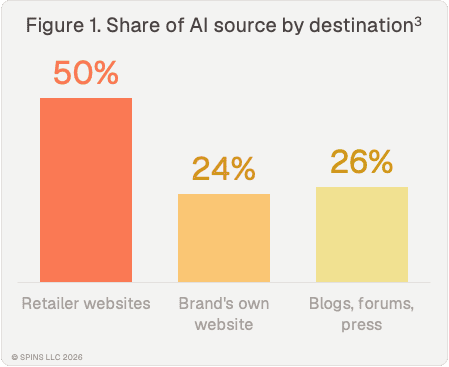
[3] Source: SPINS Foundry panel, 925 tracked prompts, 13 weeks. Week 1 (Jun 6) vs. week 13 (Aug 29) 2026
The Power of Product
Managing AI-mediated discovery is still the most significant opportunity for innovative brands to be found
In Figure 2, it is clear that brand.com still plays a powerful role in discovery. In fact, for brands under $1million, 27% of citations come from the brands’ owned surfaces. Why is that? Because a hallmark of innovative brands in the grocery space is their ability to address a deeper need state – whether it is nutritional, economic, or health outcomes. And in AI-mediated commerce, it’s the intent (more than the keyword) that matters. In other words, AI assistants are evaluating their chosen body of evidence to deliver not just recommendations, but credible solutions.
For brands – and especially smaller brands on the leading edge of consumer preference and product differentiation – the control and distribution of product truth is everything.
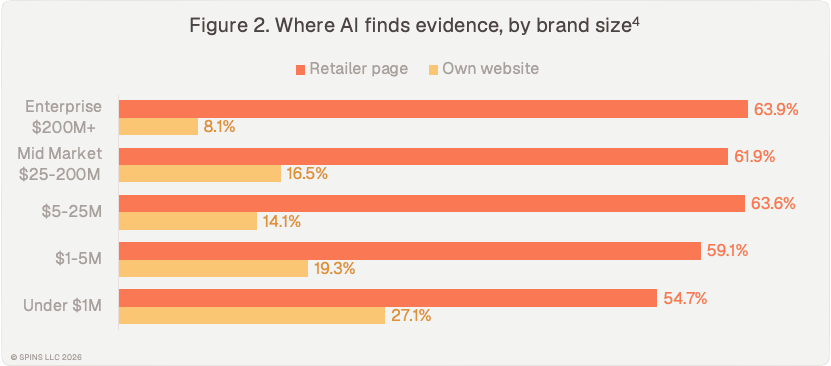
[4] Source: SPINS Foundry — the 755 prompts live in all six weeks (2026-07-04 → 08-08), evenly split across five question types and nine subcategories. Brand segments calculated using SATORI 52-weeks ending 08/09/2026 MULO w/ Convenience and Natural Expanded. Own-site share computed where the brand hostname map has coverage.
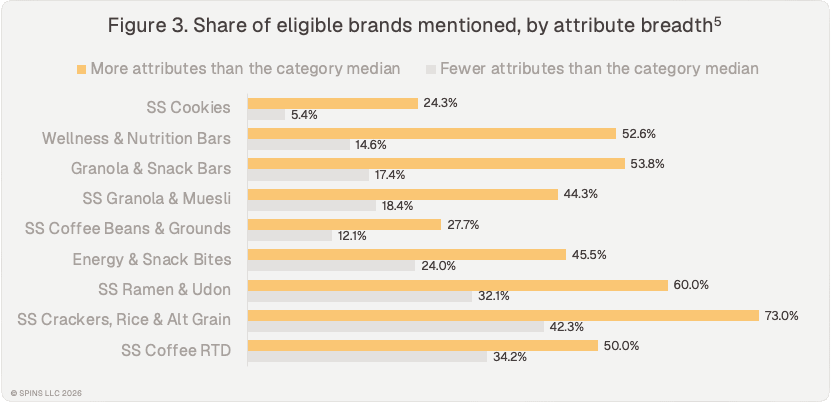
Figure 3 illuminates this imperative with a clear pattern. Across the nine categories in SPINS’ study, a larger share of brands with above-median attribute breadth appeared in AI recommendations than brands with below-median attribute breadth. The relationship remained after accounting for brand size.
Of course, this is not a causal relationship — The analysis does not show that adding more product details causes a brand to be recommended more often. Instead, and perhaps more importantly, it reveals a consistent association between the breadth of information available about a product and whether recommendation engines surface it.
The takeaway is quite as simple as “more attributes equal more recommendations.” AI assistants need enough credible product information to understand how an item relates to a shopper’s intent, preferences, and need state. Brands that communicate more dimensions of their products give these systems more evidence to evaluate that fit. For innovative brands, AI-mediated discovery therefore represents a meaningful opportunity to be considered on the strength of their differentiation and innovation, and not only the scale of their distribution or marketing budget.
[5] Source: SPINS Foundry six-week prompt panel across 755 prompts running from (2026-07-04 → 2026-08-08), evenly split across five question types and nine subcategories; Eligible = the brand qualifies for at least one attribute the panel prompts on. Brands split at their own subcategory's median attribute count.
Myth: AI Is a Singular Noun
AI assistants behave as unique shoppers, each trusting and treating evidence in different ways.
There is no such thing as “AI” – at least as a single noun. In fact, the visible differences in citation preference (retailer vs. brand.com) and even the preferences for (or against) specific retailers are so significant that it is worth considering each major LLM a distinct shopper.
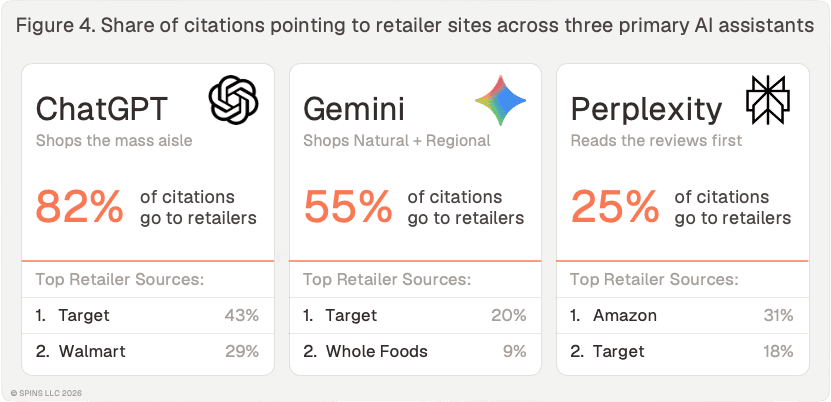
For example, while retailer pages are the dominant source of trust and citation for ChatGPT, Gemini and Perplexity don’t feel the same; just over 50% of Gemini citations go to retailers, while Perplexity gives them only 25% of the traffic (Figure 4).
Interestingly, Amazon not only makes the difference tangible, but also demonstrates the inconsistency. A recommendation from Perplexity only cited retailers 25% of the time, but 1 in 3 of those citations were Amazon. On the other side, ChatGPT includes retailer pages in 82% of citations, but Amazon only seeks out inclusion in the recommendation 1 in 76 times.
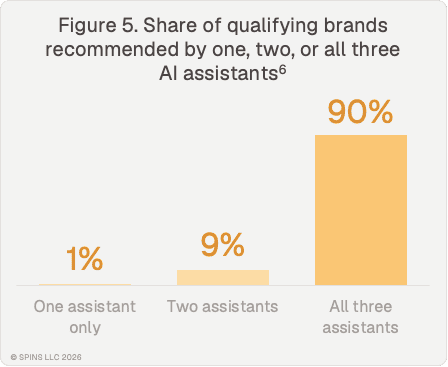
But while AI assistants may disagree about where to look in general, it is clear that they are starting to agree on the products and retailers that satisfy specific attributes and need states. And finding areas of agreement can be just as meaningful in assessing how to nurture trust.
Figure 5 shows that while the assistants use very different source mixes, 90% of the 442 qualifying brands in a particular query were considered “eligible” and recommended by all three.
Eligible = the brand qualifies for at least one attribute the panel prompts on. Brands split at their own subcategory’s median attribute count.
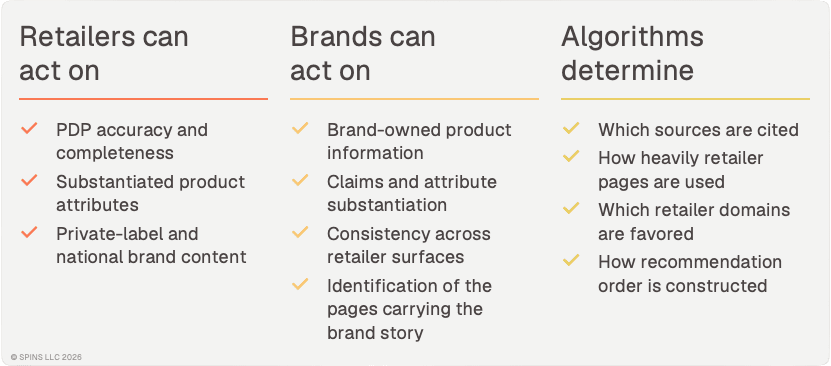
This should be quite comforting for brands and retailers, and is an important reality check in general. While AI agents carry their own preferences and biases, it is important for brands and retailers that they are not addressing three completely different universes. Rather, each of their AI shoppers is using a different set of evidence to create overlapping recommendations. The key is to recognize, but not over-rotate, on the differences. For brands, that means investing in building consistent, legible product truth that closes the gap between AI assistant recommendations; For retailers, it means knowing where their pages carry influence, and what they can do to even the playing surface.
[6] Source: SPINS Foundry six-week prompt panel across 755 prompts running from (2026-07-04 → 2026-08-08), evenly split across five question types and nine subcategories; Eligible = the brand qualifies for at least one attribute the panel prompts on. Brands are split at their own subcategory's median attribute count.
AI Owns the Evidence. Not the Narrative.
AI-mediated commerce has introduced new players and new rules. But the game is the same.
Rising above all the disruption, the role reversals, and the battle between influence and evidence, there remains familiar work to be done for brands and retailers: understand your shopper (human and agentic), own the truth about the product (ingredients, attributes, outcomes), and make that truth available where decisions are made.