


Introduction
Every launch starts with optimism. The product is ready, retailers are engaged, and growth feels within reach. But once the first few weeks of data arrive, teams face a critical question: is the launch actually succeeding?
The answer depends on context. A line extension, a new format, and a category-disrupting innovation all serve different purposes and should not be judged by the same standards. To make better decisions, companies need clear expectations, meaningful benchmarks, and a way to separate early signals from noise.
In this report, we’ll build a practical way to set expectations before spending piles up, read early signals, and make a confident call. First, let’s start with why innovation even matters in the first place.
The Launch Challenge
Innovation Is Big and Small
Innovation takes many forms, from new technologies and channel strategies to entirely new products. This report focuses on new product launches, including line extensions, new formats, pack sizes, and category entries.
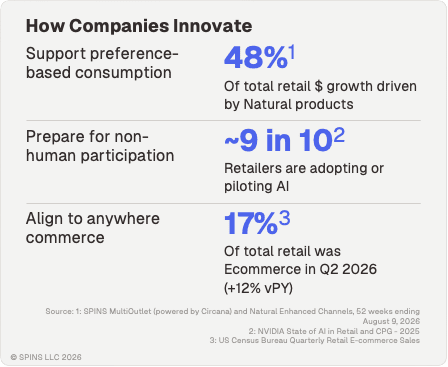
Source: [1]: SPINS MultiOutlet (powered by Circana) and Natural Enhanced Channels, 52 weeks ending August 9, 2026; [2]: NVIDIA State of AI in Retail and CPG - 2025; [3]: US Census Bureau Quarterly Retail E-commerce Sales
Innovation Remains a Top Priority and Market Accelerant
Innovation continues to be a major investment area for CPG companies. According to the SPINS executive survey, more than half of executives reported increased spending on innovation and R&D, with health and wellness, category disruption, and new category entry leading strategic priorities.
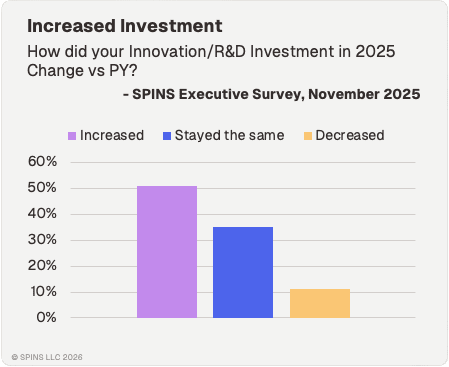
Source: SPINS Executive Survey, November 2025
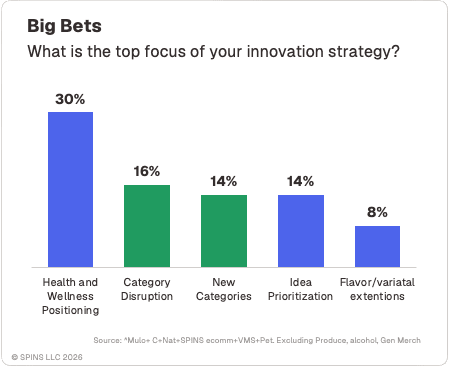
Source: ^Mulo+ C+Nat+SPINS ecomm+VMS+Pet. Excluding Produce, alcohol, Gen Merch
As companies aim to place bigger bets and move beyond their core businesses, defining success upfront becomes increasingly important.

Innovation Success Is Challenged by Market Conditions
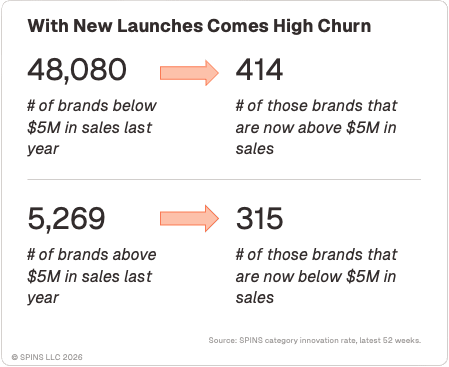
At the same time, innovation faces significant pressure. In many categories, new products are entering the market faster than distribution is growing, creating intense competition for limited shelf space.
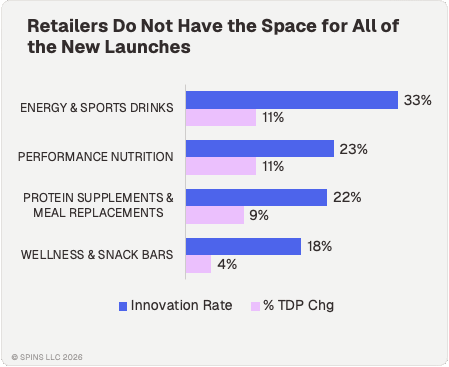
Source: SPINS category innovation rate, latest 52 weeks
Source: SPINS category innovation rate, latest 52 weeks.
Brand turnover further highlights the challenge. Thousands of brands compete for growth each year, yet relatively few successfully scale, while some established brands lose ground. Every launch enters a crowded and highly competitive environment.
Market Barriers Limit Industry Action
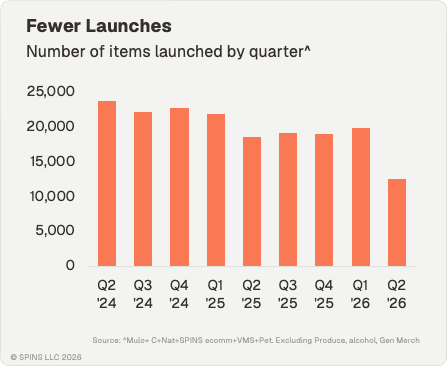
These pressures are reshaping launch behavior. New product introductions have fallen sharply in recent years, while the highest share of new product launches come from lower-risk paths: established brands in their existing categories.
Source: ^Mulo+ C+Nat+SPINS ecomm+VMS+Pet. Excluding Produce, alcohol, Gen Merch

Source: ^Mulo+ C+Nat+SPINS ecomm+VMS+Pet. Excluding Produce, alcohol, Gen Merch *Includes products with over $1,000 in retail sales
With fewer launches carrying more of the growth agenda, every decision becomes more important. Companies have fewer opportunities to get it right and less room to delay action when performance signals emerge.
As the Stakes Increase, so Does the Need for Better Decision-Making
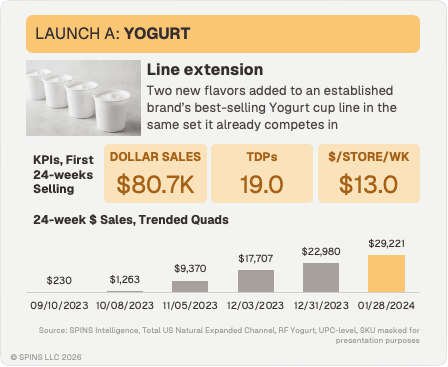
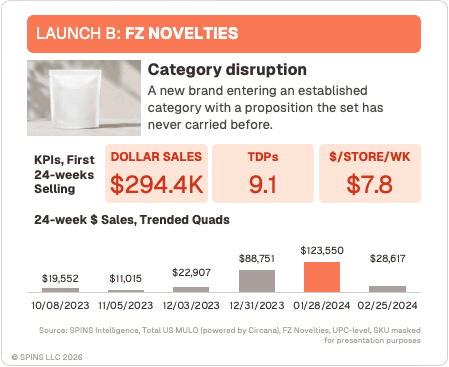
Consider two launches after 24 weeks in market. One is a yogurt line extension with stronger distribution and velocity. The other is a category-disrupting frozen novelty with significantly higher sales but lower distribution and more volatile performance.
Which deserves the next investment dollar?
Source: SPINS Intelligence, Total US Natural Expanded Channel, RF Yogurt, UPC-level, SKU masked for presentation purposes
Source: SPINS Intelligence, Total US MULO (powered by Circana), FZ Novelties, UPC-level, SKU masked for presentation purposes
The answer is not obvious because the launches were designed to do different jobs. Looking at metrics alone can point decision-makers in different directions. What is missing is the benchmark: a clear understanding of what success should look like for that type of innovation.
Without the right comparison, teams can describe performance but cannot confidently act on it. The key is to define the innovation first, then evaluate it against the right expectations.
In the next section, we explore how to define launch success and build the benchmarks needed for smarter investment decisions.
Defining Launch Success
We’ve established the challenge: fewer launches, higher stakes, and greater pressure to make the right call. The next step is defining what success should look like before a product ever reaches the shelf.
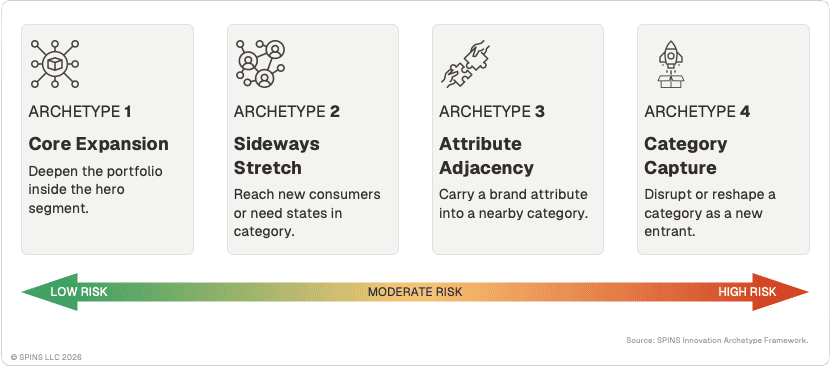
Source: SPINS Innovation Archetype Framework
Innovation Archetypes Are the Foundation
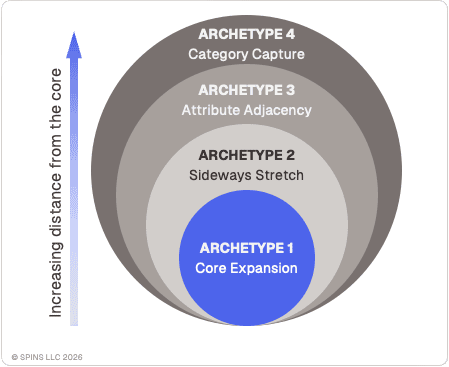
Not all innovations are designed to accomplish the same goal. That is why we use four innovation archetypes to define the role each launch is meant to play.
Core Expansion stays closest to the existing business, often extending proven products within the hero segment.
Sideways Stretch reaches a new shopper or need state within the category.
Attribute Adjacency takes a branded strength into a nearby category.
Category Capture represents the largest leap, using innovation to establish a new growth platform.
As brands move from Core Expansion to Category Capture, risk generally increases, timelines become longer, and the evidence required for success changes. By identifying the archetype first, teams create a shared understanding of what the launch is intended to accomplish and how it should be evaluated.
Launch Excellence Is Not One-Size-Fits-All
Once the archetype is defined, launch evaluation becomes a repeatable process rather than a subjective discussion.
The approach is simple:
- Define the role the innovation is expected to play.
- Establish the success metrics and timeline that fit that role.
- Compare performance against the appropriate benchmark and act on the results.
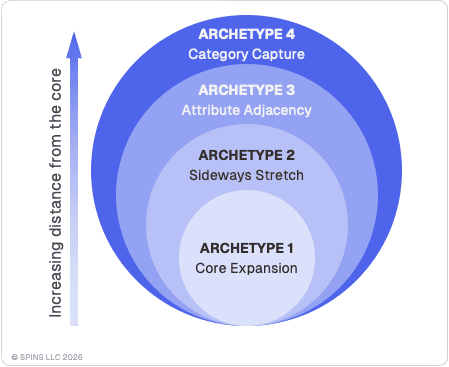
Source: SPINS Innovation Archetype Framework
The evaluation timeline is especially important. A flavor extension may prove itself quickly, while a new category platform often requires more time and different milestones before a meaningful decision can be made.
By aligning expectations before launch, brand, sales, category management, finance, and retail partners can focus on interpreting the data rather than debating what success was supposed to be.
Regardless of Archetype, Most Innovations Should Be Evaluated Against a Few Baseline Success Metrics
While success measures vary by archetype, every launch should pass a few foundational tests.
The first is distribution build: is the product securing shelf presence at the expected pace?
The second is velocity and rank: is it selling where it is stocked, and how does its performance compare to the rest of the category? Velocity shows how quickly an item moves, while rank provides important context around competitive standing and shelf retention risk.
The third is partner alignment: is the launch delivering the outcome the retailer was expecting? Depending on the retailer, success may mean driving category growth, bringing in new shoppers, or creating a new consumption occasion.
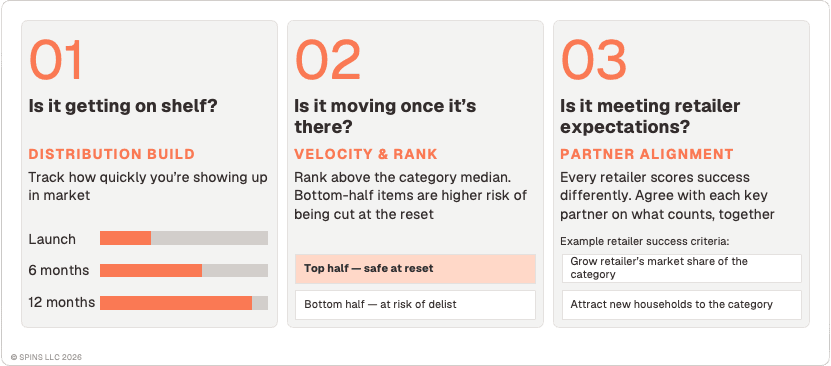
Together, these baseline metrics answer a critical question: does the item deserve to stay on shelf? From there, archetype-specific measures determine whether the innovation is fulfilling its broader strategic role for the brand.
In the next section, we explore how these success measures differ across the four innovation archetypes and what strong performance looks like for each.
Four Archetypes in Action
With the framework established, the next step is understanding what success looks like for each innovation archetype. While every launch should be evaluated using common baseline measures, the metrics that matter most depend on the job the innovation is meant to do.
Core Expansion
Core Expansion includes new flavors, pack sizes, formats, and other extensions within a brand’s core business. The objective is to strengthen the existing portfolio by giving current shoppers more reasons and occasions to buy.
The biggest risk is substitution. If a new SKU simply shifts sales from one item to another, the portfolio becomes more complex without generating meaningful growth.
Measuring Success
Success is measured by whether the extension strengthens the overall brand rather than just the new item. There is a short-term and long-term view to keep in mind.
First, we look for Brand Validation, a view to keep in mind in the short term. It’s imperative to know if the extension is deepening the brand’s shelf presence. The metric to help you answer that is:
- Average Items Carried, which measures the average number of brand items carried when the brand is sold
Then, we look for Consumer Validation, a view to keep in mind in the long term. It’s important to know if consumers are buying the brand on more occasions. The metric to help you answer that is:
- Brand Buy Rate, which measures average dollars or units purchased per buyer
Together, these metrics show whether the extension is expanding the brand’s footprint both on shelf and in consumers’ baskets.
In Action: Painterland Sisters
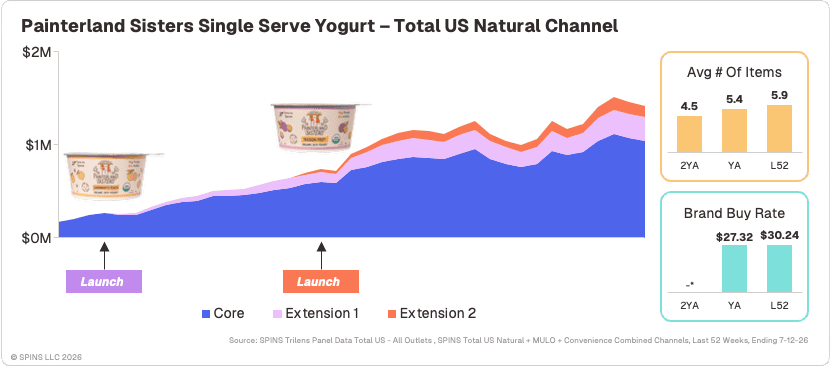
Painterland Sisters demonstrates what a successful Core Expansion can achieve. As new flavors were introduced, the overall brand continued to grow rather than shifting sales among existing products.
Source: SPINS Trilens Panel Data Total US - All Outlets , SPINS Total US Natural + MULO + Convenience Combined Channels, Last 52 Weeks, Ending 7-12-26
Average items carried increased from 4.5 to 5.9, while brand buy rate rose from $27.32 to $30.24. Retailers stocked more of the brand, shoppers spent more with the brand, and the core business remained healthy, indicating that the extensions strengthened the portfolio rather than cannibalizing it.
Sideways Stretch
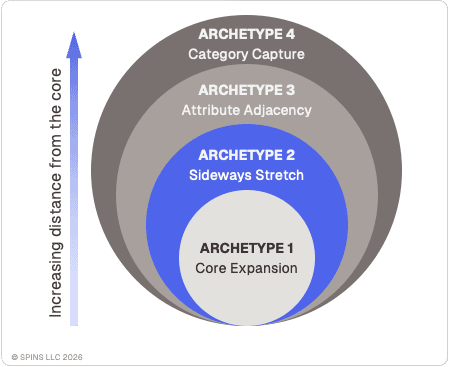
Sideways Stretch remains within the same category but expands the brand’s reach to new shoppers, occasions, or need states.
The brand promise remains familiar, but the use case broadens. This can include new formats, portion sizes, or benefits that make the brand relevant in additional situations.
Measuring Success
Success is determined by whether the launch attracts new buyers and drives incremental growth. There is a short-term and long-term view to keep in mind.
This time, we look for Consumer Validation first in the short term. Here we have to ask if the innovation is attracting shoppers who were not already buying the brand. The metric to help you answer that is:
- % Households Buying, which is the percentage of total households buying the brand
Then, we look for Brand Validation in the long term. We have to think about whether the innovation is driving additional brand sales while maintaining the existing consumer base instead of just cannibalizing sales. The metric to help you answer that is:
- Incremental sales, which measure additional sales above the expected no-launch baseline
A Sideways Stretch is successful when it expands the audience while also growing the total brand.
In Action: Olipop Mini Cans
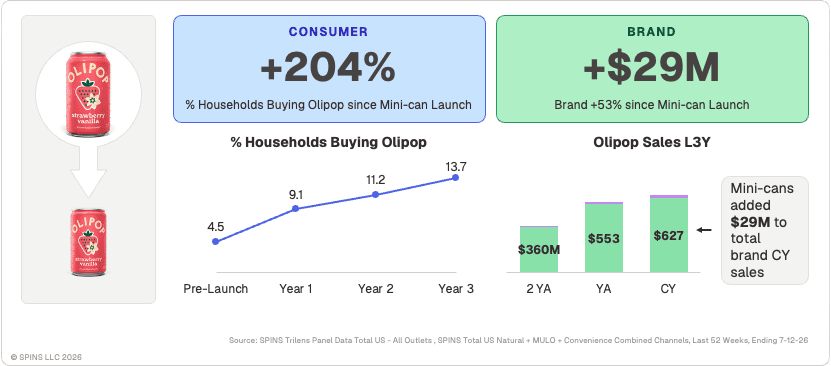
Olipop’s Mini Cans illustrate this archetype in action. The smaller format maintained the brand’s core proposition while opening new consumption occasions and serving different shopper needs.
Source: SPINS Trilens Panel Data Total US - All Outlets , SPINS Total US Natural + MULO + Convenience Combined Channels, Last 52 Weeks, Ending 7-12-26
Household penetration increased from roughly 4.5% before launch to 13.7% three years later, representing more than a threefold increase. The format also generated $29 million in annual sales while the total brand grew 53%.
The result was exactly what Sideways Stretch is designed to deliver: more buyers, more occasions, and more total brand growth.
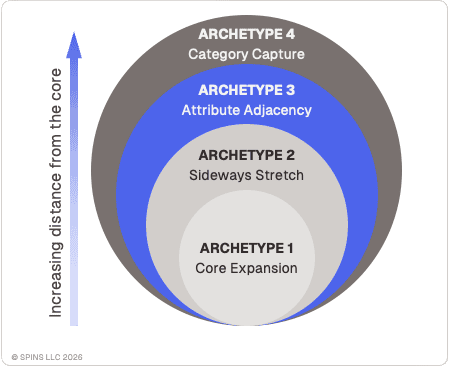
Attribute Adjacency
Attribute Adjacency occurs when a brand takes a defining strength into a neighboring category.
The category changes, but the underlying consumer need remains similar. The challenge is determining whether consumers believe the brand belongs in the new space.
Measuring Success
Success requires consumers to understand why the brand belongs in the new category and for the growth to go beyond the category’s existing momentum.
Here again, we look for Consumer Validation first in the short term. We should ask ourselves if the brand is earning permission to compete in the adjacent category. The metric to help you answer that is:
- Cross-purchase, which is a percentage of existing brand households that also purchase the brand in the new category
Then, we look for Brand Validation in the long term. Here, it is imperative to question if the innovation is unlocking new sources of growth. The metric to help you answer that is:
- Growth Multiple, which is the brand’s share of category growth compared with its share of category sales.
One metric confirms that brand equity is transferring. The other confirms that the new category can become a meaningful growth opportunity.
In Action: Bloom
Bloom’s move into energy drinks demonstrates a successful Attribute Adjacency strategy.
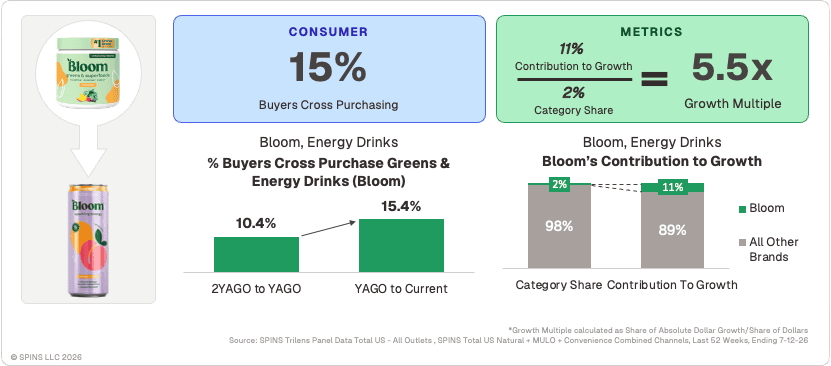
15% of Bloom households also purchased the energy drink in the current year, gaining 5 points from the period prior. This indicates that consumers readily extended their relationship with the brand into the adjacent category.
Source: SPINS Trilens Panel Data Total US - All Outlets , SPINS Total US Natural + MULO + Convenience Combined Channels, Last 52 Weeks, Ending 7-12-26 *Growth Multiple calculated as Share of Absolute Dollar Growth/Share of Dollars
At the same time, Bloom accounted for roughly 2% of category sales but approximately 11% of category growth, creating a Growth Multiple of 5.5x. The brand’s influence on category growth far exceeded its current size, suggesting strong long-term potential.
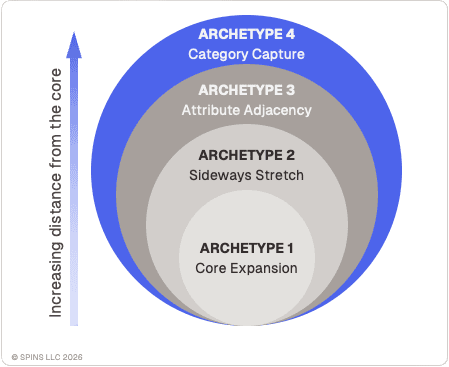
Category Capture
Category Capture represents the largest leap from a brand’s core business. The objective is not simply to launch a new product but to create a new growth platform within an entirely different category.
These launches typically involve higher risk, longer timelines, and greater investment. As a result, they require patience and clear milestone-based evaluation.
Measuring Success
Success requires showing that consumers are trying the product, integrating it into their routines, and showing that the launch is becoming a meaningful growth engine for the category.
We first look at Consumer Validation in the short term. We need to ask two questions: Are consumers adopting the proposition, and are they returning? The two metrics to help answer that are:
- Household penetration, which is the percentage of households that bought at least once. This will tell us whether the innovation is attracting new buyers.
- Repeat rate, which is the percentage of households that bought 2 or more times. This tells us whether you are creating loyalty beyond an initial purchase.
Then, we look for Brand Validation in the long term. Here, we have to question if the innovation is becoming a meaningful growth engine for both the brand and the retailer. The metric to help you answer that is:
- Contribution to Growth, which measures the share of the total category growth generated by your brand. This shows us whether the innovation is having broad impact beyond your brand itself.
Together, these metrics show whether the proposition is gaining traction and beginning to shape the category itself.
In Action: Fishwife
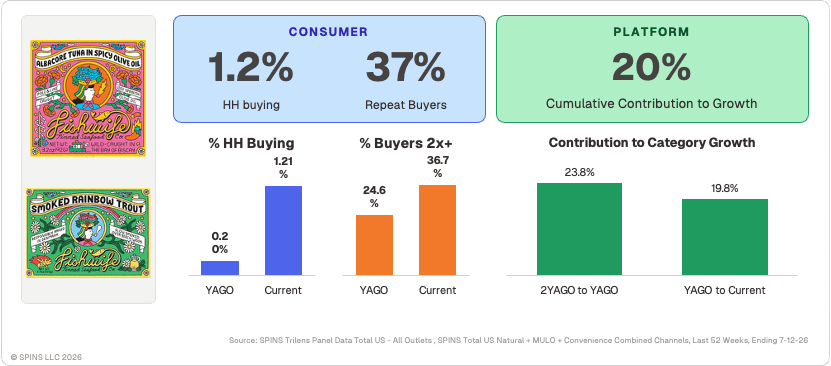
Fishwife exemplifies Category Capture. Household penetration increased from 0.20% to 1.21%, while repeat buying grew from 24.6% to 36.7%.
The brand also contributed roughly 20% of total category growth, demonstrating an impact well beyond its own sales performance.
Source: SPINS Trilens Panel Data Total US - All Outlets , SPINS Total US Natural + MULO + Convenience Combined Channels, Last 52 Weeks, Ending 7-12-26
These signals point to a launch that is building both consumer adoption and category influence, two critical components of a successful Category Capture strategy.
Turning Signals Into Decisions
Across all four archetypes, the pattern is the same: define the job first, measure against the right success criteria, and evaluate performance within the proper context. The final step is turning those signals into decisions about where to invest, where to adjust, and where to move on.
A strong launch framework is only valuable if it leads to better decisions. Once the archetype is defined, the benchmark is established, and the results are measured, the final step is deciding what to do next.
Acting On The Data
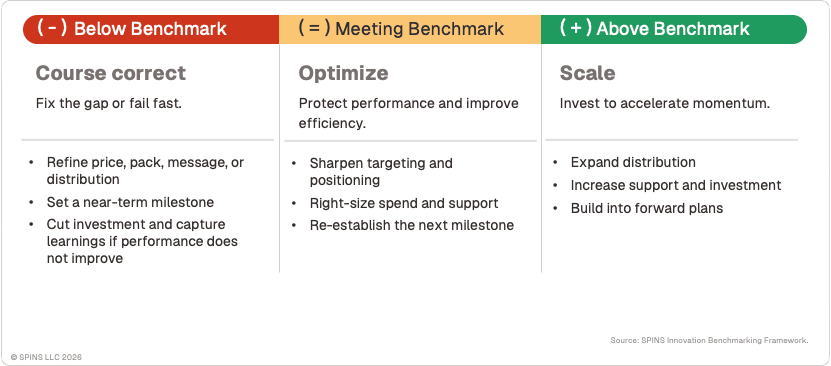
Benchmarks create three clear paths for action.
Source: SPINS Innovation Benchmarking Framework
When a launch is performing below benchmark, the goal is not to abandon it immediately, but to identify the specific gap. The issue may be distribution, pricing, packaging, messaging, or another execution factor. Teams should define a near-term milestone, monitor progress closely, and be prepared to move on if performance does not improve.
When a launch is performing at benchmark, the focus shifts to optimization. The product has earned further support, but there is still an opportunity to strengthen execution, refine marketing efforts, and establish the next set of targets.
When a launch is performing above benchmark, the priority is scale. That may mean expanding distribution, increasing investment, or incorporating the innovation into longer-term growth plans.
The value of this approach is that decisions are driven by predefined expectations rather than emotion, optimism, or sunk costs. The benchmark becomes the decision rule.
Launch Excellence Starts Before The Shelf
The principles of launch excellence can be summarized in three steps:
- Define the job the innovation is meant to do.
- Select the measures and timeline that fit that job.
- Compare performance against the benchmark and act on the results.
When organizations follow this process, successful launches receive support more quickly, struggling launches receive targeted intervention, and teams gain a common definition of what success looks like.