

Introduction
Private label used to mean plain packaging and “good enough” products that shoppers bought only to save money, and were sometimes a little embarrassed to buy. Not anymore. Today, store brands are seen as cool, and shoppers are no longer shy about buying them.
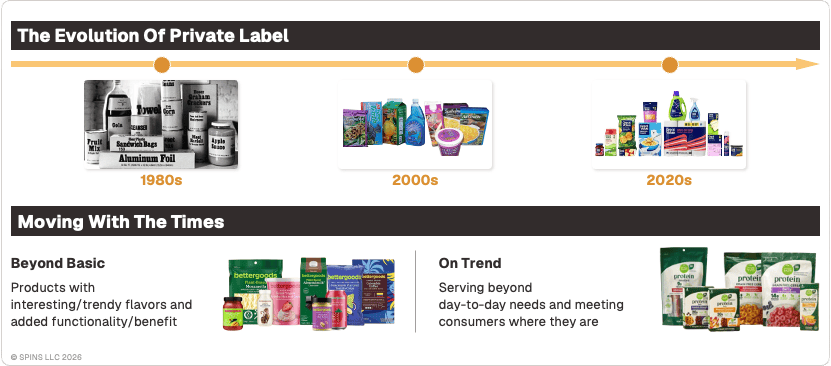
Retailers have moved beyond basic pantry copies to exciting flavors, new product types and on-trend options like high-protein and plant-based items. Keeping up with the times is driving new interest in private label.
Evolving Shopper Preferences
From Trade-Down to Habit
Inflation sped up private label adoption, but most recent dollar growth now comes from existing households buying more often, followed by new households trying it. That shift shows private label becoming part of shoppers’ routines, not just a fallback when prices rise.
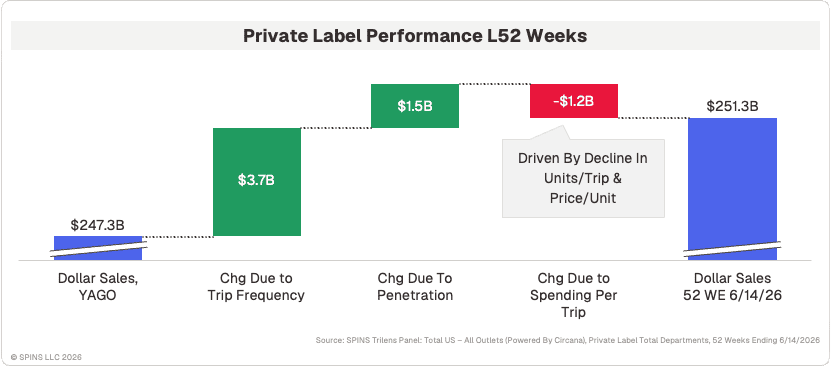
Growth is led by frequently bought staples such as cheese, milk, eggs, bottled water, fresh bread, household goods and meat. To keep that habit growing, retailers need to keep innovating with differentiated products like plant-based and high-protein options and new flavors. Private label’s future depends on more than low prices.
Not Just for Budget Shoppers
Private label once appealed mainly to budget-conscious households, but that is changing. Higher-income households now have the highest adoption rates, a sign that shoppers see private label as a quality choice.
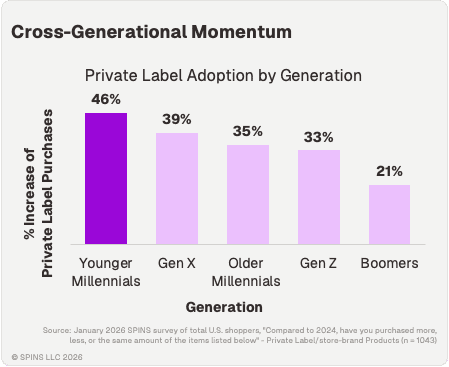
Younger generations are also leading adoption. Both groups are adding growth in everyday staples such as fresh bread, protein, refrigerated dairy and household goods. Private label is no longer just a value play; it is a mainstream choice across incomes and generations.
Younger Shoppers, Outsized Impact
Gen Z and Millennials are punching well above their weight in private label. Together they make up just 17% of households but account for 81% of private label’s year-over-year dollar growth.
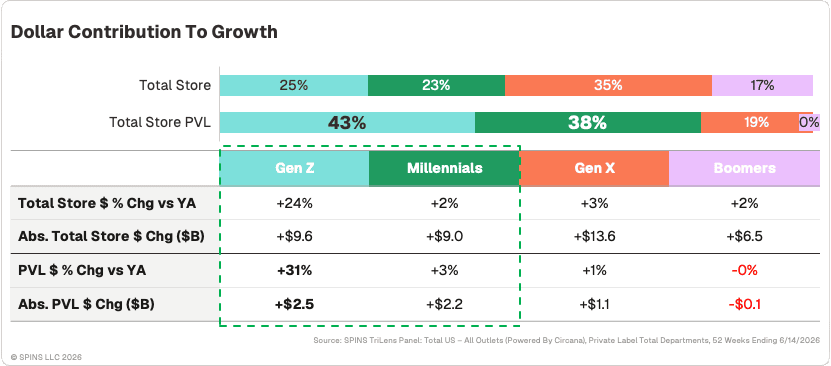
That makes younger shoppers essential for any retailer that wants to win in private label. To reach them, retailers should go beyond traditional value messaging. Instead, they should focus on what resonates with younger shoppers: innovation, convenience and premium experiences.
Building Loyalty for the Future
Gen Z is becoming one of the most important drivers of future private label growth. Its share of growth is higher than its share of shoppers in nearly every department, especially refrigerated and beverages, while Millennials over-index in frozen. As these shoppers move into life stages where they spend more, retailers have a real chance to build lasting loyalty to their brands. Frequently bought perishables are the clearest place to start. There is also room to bring more innovation to other categories.
Private Label Performance
Holding Share as Momentum Cools
Private label continues to outpace national brands, holding a steady dollar share of roughly 22% while growing 3.1%. That points to lasting, structural share gains, even as short-term momentum fades. Quarterly dollar growth peaked at around 6.1% in early 2025 and has since swung to -2.9% in the latest 12-week period, while unit growth peaked at 3.6% in early 2024 and closed the latest period at -1.3%.
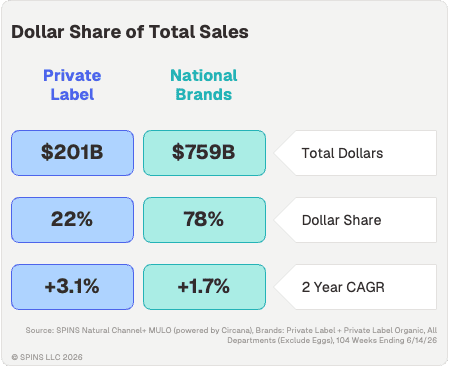
About 90% of recent dollar losses came from refrigerated departments, especially eggs, cheese, milk, alternative dairy and creamers. Unit and dollar trends are still moving apart, so it’s worth watching whether assortment changes or price adjustments are behind the gap.
Where the Next Wave of Growth Lies
Private label still has plenty of room to grow, led by fresh proteins, prepared foods and center-store staples. Refrigerated beef, protein and seafood lead dollar growth, but not unit growth, which points to higher price points per unit, price increases or both.
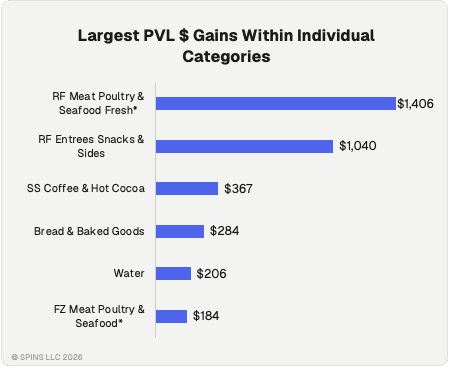
Fresh refrigerated beef alone accounts for nearly $1 billion in growth, followed by seafood and chicken, making refrigerated fresh proteins the largest private label opportunity. Refrigerated entrees lead unit growth, showing strong volume gains in convenience meals. Private label sales are also outpacing national brands in categories like shelf-stable plant-based milks and kombucha and other functional beverages, suggesting shoppers are trading down on price without leaving the category.
A Widening Value Gap
Over the last two years, national brand average retail prices have risen faster than the CPI food-at-home index, the government’s measure of grocery inflation. Private label prices, by contrast, have stayed below that index, and retailers leaned into private label pricing during the 2025 holidays.
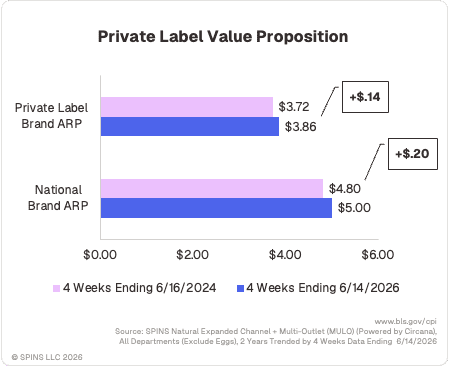
Private label’s average retail price has risen just 14 cents, from $3.72 two years ago to $3.86 today, while national brands rose 20 cents to $5.00, now $1.14 more than private label. As a result, private label’s value advantage over national brands has grown 6%. The key question ahead is whether private label prices creep back up toward inflation and national brand increases, or whether retailers keep using private label to deliver value to shoppers across income brackets.
Value Drivers Within Private Label
Meeting Every Shopper in an E-Shaped Economy
Some economists are moving from describing the U.S. as a K-shaped economy to an E-shaped one, which adds a clearer view of the middle class. At the top of the E, affluent shoppers spend comfortably and choose private label for product attributes, such as added protein or no added sugar, that national brands aren’t offering. At the bottom, lower-income households shop private label for the value it brings to their basket, the role store brands have traditionally played.
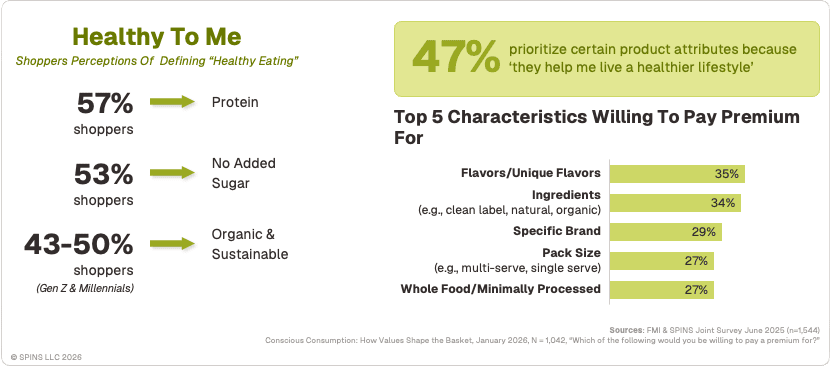
The middle line represents a squeezed middle class that is trending down and looking for ways to live within its means. These shoppers still prioritize attributes like organic or clean ingredients, and retailers are answering with more premium private label offerings so they no longer have to pay up for national brands.
Premium Is Now an Attribute, Not a Price Point
At the lower end of the E, 60% of shoppers are comparing prices and 43% have cut back on store trips, shifting from exploration to efficiency. For these shoppers, a product like Walmart’s Great Value cream cheese is the value choice in the category. In the middle and at the top of the E, shoppers are buying with intention and defining premium by attributes rather than price. National retailers like Walmart and Kroger are responding with tiers of private label in the same category. Walmart launched bettergoods regular and dairy-free cream cheese as a premium private label option, with a clean label free of gums, stabilizers and artificial ingredients.
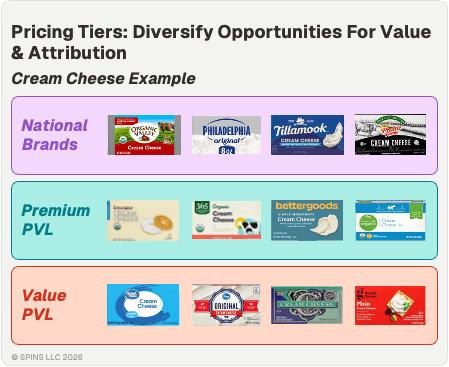
Shoppers who value those attributes can pay a premium over Great Value. Kroger offers similar tiers, with its Kroger-brand cream cheese alongside an organic option from its Simple Truth brand. Premium private label gives shoppers a third choice in store beyond value private label and national brands.
Over the last 52 weeks, private label organic cream cheese has been having its moment. Despite higher average retail prices, its dollars and units are up, with dollar growth accelerating to 89% over the last 12 weeks. Value private label, by contrast, saw price decreases over the last 52 weeks, giving shoppers some relief, but its dollar growth declined.
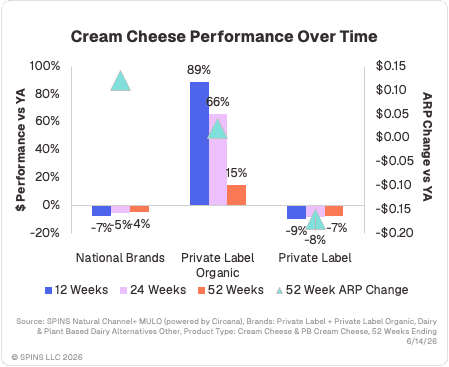
This could mean shoppers traded up to private label organic. It could also mean that, with costs rising across their whole basket, shoppers decided cream cheese is something they can live without, as units per trip fell for households across the total store. Either way, offering three tiers lets a retailer meet each shopper where they are.
How Premium Private Label Reset Category Pricing
Datasembly’s competitive pricing data, which covers more than 100,000 brick-and-mortar stores, shows what happens to a category when a national retailer launches a premium private label product. Before its premium private label cream cheese launched, Retailer A carried a conventional national brand priced above $7, higher than that brand’s U.S. average, and a natural national brand at around $4, in line with premium private label prices nationally.
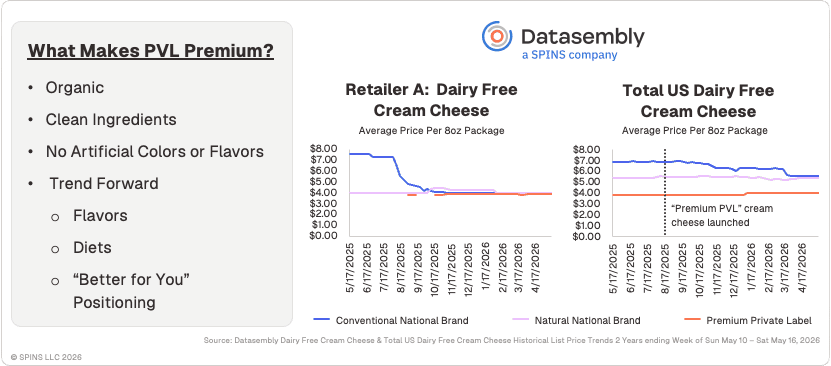
After the launch, the conventional national brand quickly cut its price to compete with the new private label option. Today, all three tiers at Retailer A sit around $4 for an 8-ounce package, and the conventional brand’s price is trending down across the U.S. as well. One premium private label launch drove value across the whole category and served shoppers on all three lines of the E-shaped economy.
Private Label Innovation In Today's Marketplace
Three Forces Shaping What Shoppers Want
Today’s shoppers want more than value: they want the on-trend products they see from national brands, at a price private label can deliver. Three forces are driving that shift. The first is intentional eating, with around 40% of Gen Z and Millennial shoppers following a specific diet and avoiding ingredients like corn syrup, artificial sweeteners and sugar alcohols, which makes clean labels a baseline expectation rather than a differentiator.
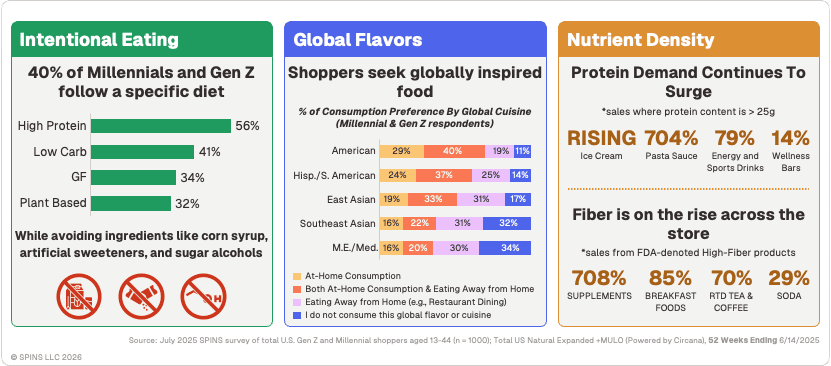
The second is nutrient density, as demand for high-protein products keeps surging in categories from supplements and breakfast foods to soda, and fiber gains momentum as an everyday wellness expectation. The third is global flavor exploration, with shoppers seeking flavors inspired by world cuisines in mainstream categories like pasta sauces, wellness bars and even ice cream. Together, these trends create a clear road map: products that support wellness goals, deliver real nutrition and offer exciting flavors, all with the value shoppers expect from private brands.
Where Private Label Has Room to Grow
Mapping categories by how much younger shoppers over-index against how much share private label already holds reveals where the white space is. The most interesting area is the “innovation opportunity” quadrant, made up of categories where younger shoppers are highly engaged but private label has captured little share. Energy drinks, yogurt and frozen pizza stand out, with strong demand from young consumers and relatively low private label penetration.
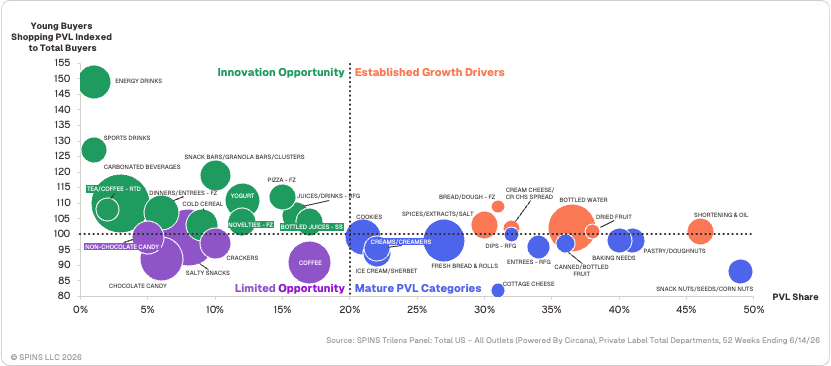
By contrast, categories like bottled water, baking needs and oils already have a strong private label presence, so they can keep growing but offer less room for new innovation. The next wave of private label growth may come from categories where young shoppers are already enthusiastic and retailers can stand out through innovation, trends, premiumization and unique offerings.
From Trend to Shelf
Once the trends are clear, the next step is turning those insights into products. Mapping product concepts against trends with growing momentum shows where consumer demand is strong but product choice is still limited. When an attribute is growing in importance but isn’t yet showing up widely across categories, that’s often where the next private label opportunity lies.
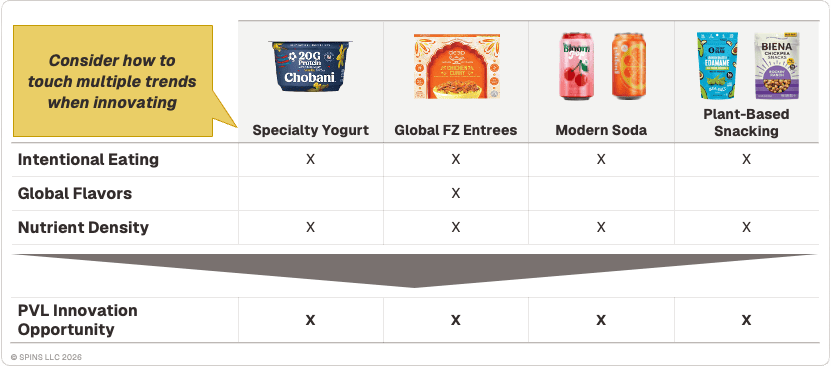
The strongest concepts stack several trends together, like a modern soda that delivers functional benefits through nutrient density while tapping into interest in bold, globally inspired flavors. Meeting several consumer needs in one product, rather than chasing a single trend, broadens appeal and helps future-proof innovation as trends evolve.
Pathway 1: Conscious Consumption
Consumer values are evolving, and private label is keeping pace, though affordability still matters. Shoppers increasingly want products that match their values, whether that means clean ingredients, functional benefits, quality or sustainability, and private label is uniquely positioned to deliver.
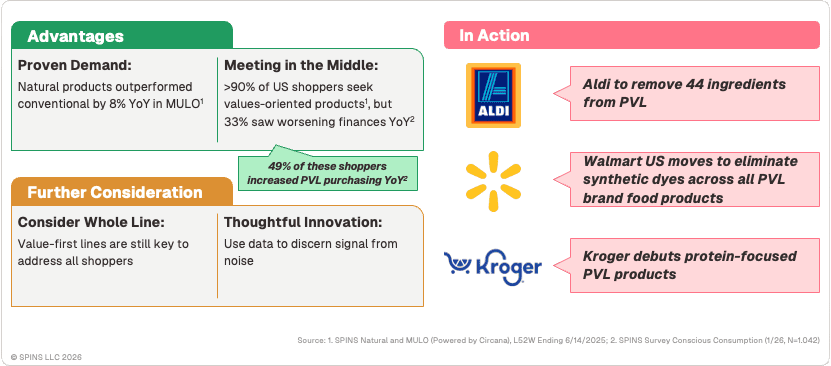
Natural products grew 8% faster than conventional products in MULO, and nearly half of those shoppers are buying more private label than they did a year ago, a sign that they are actively choosing it rather than settling for it. Still, shoppers are balancing values with their wallets: more than 90% are seeking value-oriented products, and a third say their finances have worsened over the past year, so a strong value-tiered assortment remains critical. Retailers are already acting: Aldi is removing 44 ingredients from its private label portfolio, Walmart is eliminating synthetic dyes across its private label food brands, and Kroger is expanding into protein-focused private label products. The key is using data to separate lasting consumer shifts from passing trends and investing where demand is truly building.
Pathway 2: Fast Follows
Fast follows use speed to turn private label from a lower-cost alternative into a destination brand. Instead of reacting to the market, retailers spot trends early and get trend-forward products on shelf quickly, shifting private label toward a “retailer as a brand” model. When retailers consistently deliver products shoppers are excited about, private label becomes a first choice rather than a fallback, driving trial and attracting shoppers who might never have considered it.
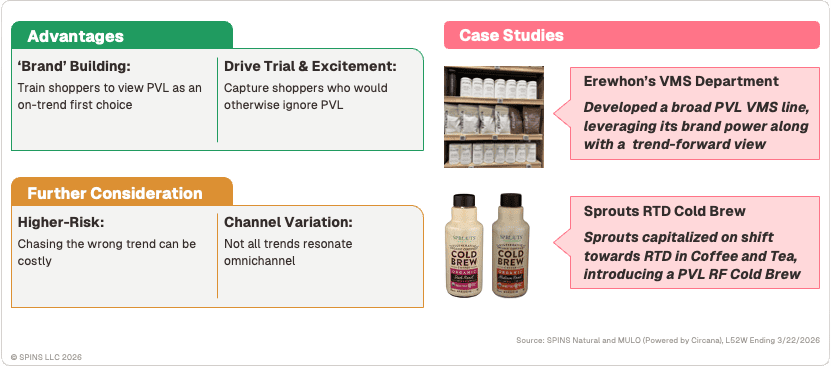
Speed carries risk, though, because not every trend lasts or resonates across channels, and chasing the wrong one can mean costly inventory and added complexity, so retailers need category and shopper data to pick opportunities likely to stick. Erewhon has built an extensive private label vitamin and supplement portfolio that reaches beyond core categories like protein into emerging trends like sea moss, and nearly 30% of its VMS sales now come from private label, compared with about 8% across the broader channel. In coffee, ready-to-drink units are up 3% for the year while beans and grounds are down 2%, and Sprouts moved quickly to capture the shift by launching a private label refrigerated cold brew in January.
Pathway 3: Limited-Time Offerings
Limited-time offerings (LTOs) are a lower-risk way to test emerging trends, learn what resonates and keep shoppers engaged before making a permanent commitment. They create excitement and urgency, giving shoppers a reason to check back often and boosting both trial and repeat visits. LTOs also put more demand on R&D, sourcing and store teams, so success depends on strong execution, and products too similar to existing items may simply shift sales rather than grow them.
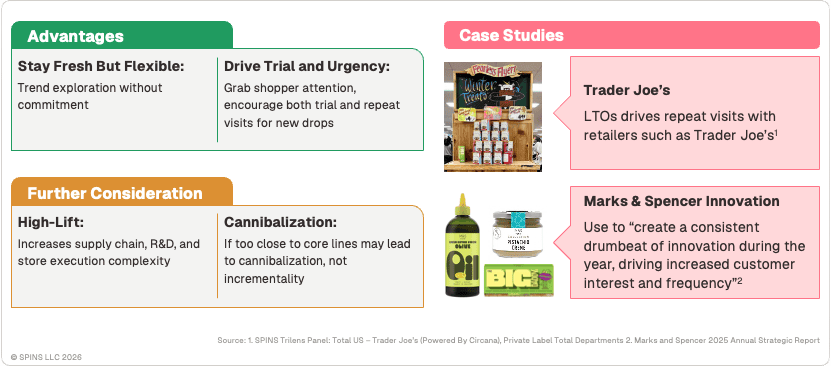
The best LTOs bring in new occasions, new customers and new spending. Trader Joe’s builds anticipation into the shopping experience by constantly refreshing seasonal and limited-time items, so shoppers know there’s always something new that may not be around for long, and 76% of its shoppers revisit, outperforming several natural and specialty competitors. Marks & Spencer keeps innovation flowing all year instead of relying on a few big launches, introducing more than 1,400 new items in 2025, many of them limited-time or seasonal, to create a steady stream of new products that keeps shoppers coming back.
Private Label's Staying Power
Private label is no longer just a value play; it has become a long-term growth driver. Its relevance keeps growing for three key reasons. First, it resonates across generations, with younger shoppers helping fuel adoption. Second, it has proven resilient, benefiting from market shifts such as supply challenges, pricing changes and brand exits. Third, innovation is expanding its role beyond value, as retailers increasingly compete through trends, premium offerings and limited-time launches. Together, these factors position private label for continued growth and importance in the years ahead.
